407. Trapping Rain Water II
Given an m x n matrix of positive integers representing the height of each unit cell in a 2D elevation map, compute the volume of water it is able to trap after raining.
Note:
Both m and n are less than 110. The height of each unit cell is greater than 0 and is less than 20,000.
Example:
Given the following 3x6 height map:
[
  [1,4,3,1,3,2],
  [3,2,1,3,2,4],
  [2,3,3,2,3,1]
]

Return 4.

The above image represents the elevation map [[1,4,3,1,3,2],[3,2,1,3,2,4],[2,3,3,2,3,1]] before the rain.
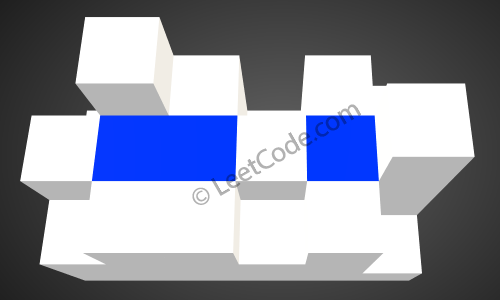
After the rain, water are trapped between the blocks. The total volume of water trapped is 4.
Solution: Heap
import heapq


class Solution(object):
    def trapRainWater(self, heights):
        """
        :type heights: List[List[int]]
        :rtype: int
        """
        if not heights:
            return 0

        rain = 0
        rows = len(heights)
        cols = len(heights[0])
        visited = [[False] * cols for _ in xrange(rows)]

        q = []
        for row, col in self.border(rows, cols):
            visited[row][col] = True
            heapq.heappush(q, (heights[row][col], row, col))

        while q:
            height, row, col = heapq.heappop(q)
            for i, j in self.neighbors(row, col, rows, cols):
                if not visited[i][j]:
                    visited[i][j] = True
                    if heights[i][j] < height:
                        rain += height - heights[i][j]
                        heights[i][j] = height
                    heapq.heappush(q, (heights[i][j], i, j))
        return rain

    def neighbors(self, row, col, rows, cols):
        for x, y in (1, 0), (-1, 0), (0, 1), (0, -1):
            i, j = row + x, col + y
            if 0 <= i < rows and 0 <= j < cols:
                yield i, j

    def border(self, rows, cols):
        for col in xrange(0, cols):
            yield 0, col
        for row in xrange(1, rows):
            yield row, cols - 1
        if rows > 1 and cols > 1:
            for col in xrange(cols - 2, -1, -1):
                yield rows - 1, col
            for row in xrange(rows - 2, 0, -1):
                yield row, 0
Lessons:
- Once fill water in a cell, set height of the cell to the water level, and push this height to heap.