218. The Skyline Problem
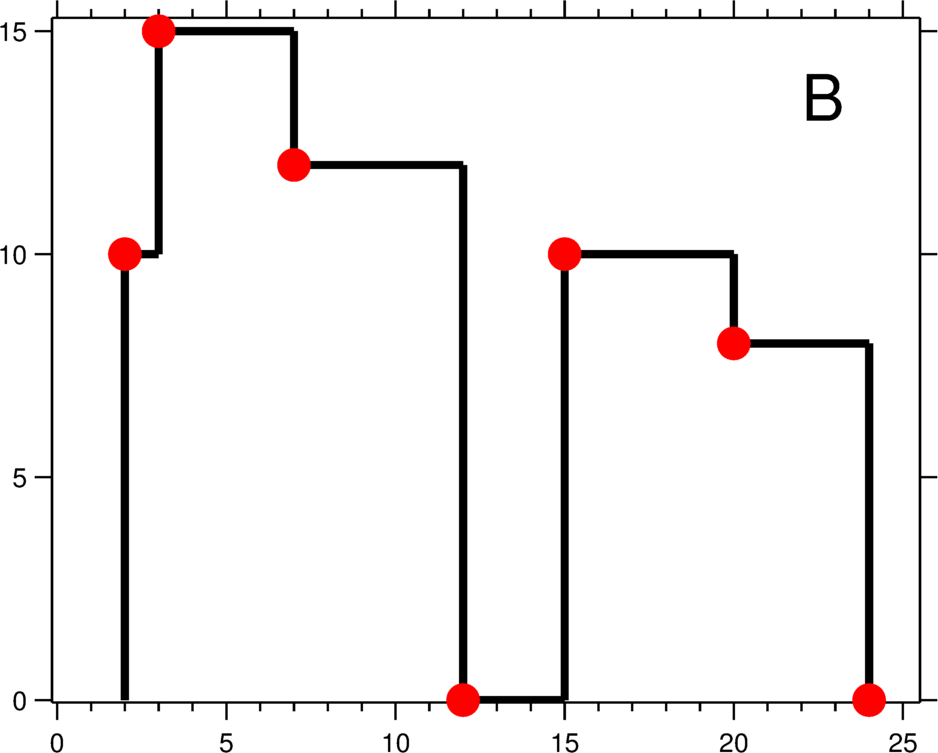
A city's skyline is the outer contour of the silhouette formed by all the buildings in that city when viewed from a distance. Now suppose you are given the locations and height of all the buildings as shown on a cityscape photo (Figure A), write a program to output the skyline formed by these buildings collectively (Figure B).
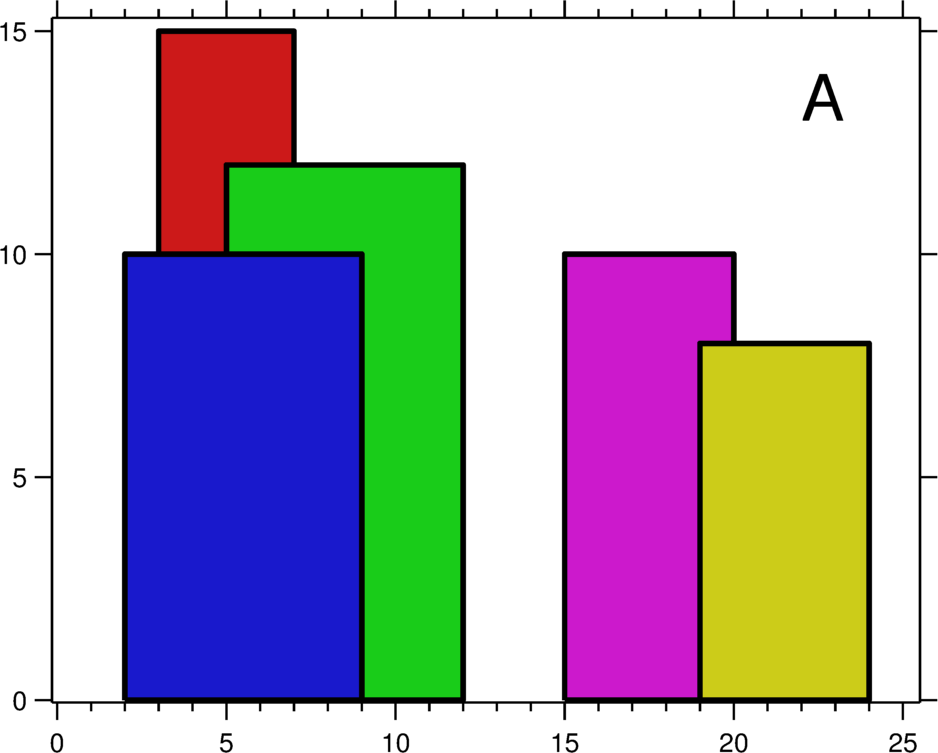
The geometric information of each building is represented by a triplet of integers [Li, Ri, Hi], where Li and Ri are the x coordinates of the left and right edge of the ith building, respectively, and Hi is its height. It is guaranteed that 0 ≤ Li, Ri ≤ INT_MAX, 0 < Hi ≤ INT_MAX, and Ri - Li > 0. You may assume all buildings are perfect rectangles grounded on an absolutely flat surface at height 0.
For instance, the dimensions of all buildings in Figure A are recorded as: [[2, 9, 10], [3, 7, 15], [5, 12, 12], [15, 20, 10], [19, 24, 8]].
The output is a list of "key points" (red dots in Figure B) in the format of [[x1,y1], [x2, y2], [x3, y3], ...] that uniquely defines a skyline. A key point is the left endpoint of a horizontal line segment. Note that the last key point, where the rightmost building ends, is merely used to mark the termination of the skyline, and always has zero height. Also, the ground in between any two adjacent buildings should be considered part of the skyline contour.
For instance, the skyline in Figure B should be represented as: [[2, 10], [3, 15], [7, 12], [12, 0], [15, 10], [20, 8], [24, 0]].
Notes:
- The number of buildings in any input list is guaranteed to be in the range
[0, 10000]. - The input list is already sorted in ascending order by the left x position
Li. - The output list must be sorted by the x position.
- There must be no consecutive horizontal lines of equal height in the output skyline. For instance,
[...[2, 3], [4, 5], [7, 5], [11, 5], [12, 7], ...]is not acceptable; the three lines of height 5 should be merged into one in the final output as such:[...[2, 3], [4, 5], [12, 7], ...]
Solution: Sweep Line & Max Heap
Python
class MaxHeap:
    def __init__(self):
        self.q = []
        self.nums = dict()
        self.size = 0

    def __len__(self):
        return self.size

    def add(self, num):
        if num in self.nums:
            self.nums[num] += 1
        else:
            heapq.heappush(self.q, -num)
            self.nums[num] = 1
        self.size += 1

    def remove(self, num):
        if num not in self.nums:
            return
        self.nums[num] -= 1
        if self.nums[num] == 0:
            del self.nums[num]
        while self.q and self.top() not in self.nums:
            heapq.heappop(self.q)
        self.size -= 1

    def top(self):
        return -self.q[0]

    def pop(self):
        num = self.top()
        self.remove(num)
        return num
class Solution(object):
    def getSkyline(self, buildings):
        """
        :type buildings: List[List[int]]
        :rtype: List[List[int]]
        """
        skyline = []

        # sweep line
        corners = []
        for left, right, height in buildings:
            corners.append((left, -height))
            corners.append((right, height))
        corners.sort()

        # max heap with lazy deletion
        q = MaxHeap()
        q.add(0)
        pre = 0
        for x, y in corners:
            if y < 0:
                q.add(-y)
            else:
                q.remove(y)
            y = q.top()
            if y != pre:
                skyline.append([x, y])
                pre = y
        return skyline
Java
public class Solution {
    public List<int[]> getSkyline(int[][] buildings) {
        List<int[]> skyline = new ArrayList<>();

        // sweep line
        List<int[]> corners = new ArrayList<>();
        for (int[] building: buildings) {
            corners.add(new int[]{building[0], -building[2]});
            corners.add(new int[]{building[1], building[2]});
        }
        corners.sort((a, b) -> a[0] == b[0] ? a[1] - b[1] : a[0] - b[0]);

        // max heap with lazy deletion
        Map<Integer, Integer> removes = new HashMap<>();
        Queue<Integer> q = new PriorityQueue<>(Collections.reverseOrder());
        q.offer(0);
        int pre = 0;
        for (int[] corner : corners) {
            int x = corner[0], y = corner[1];
            if (y < 0) {
                q.offer(-y);
            } else {
                int count = removes.getOrDefault(y, 0);
                removes.put(y, count + 1);
                while (removes.containsKey(q.peek())) {
                    y = q.poll();
                    count = removes.get(y) - 1;
                    if (count == 0) {
                        removes.remove(y);
                    } else {
                        removes.put(y, count);
                    }
                }
            }
            y = q.peek();
            if (y != pre) {
                skyline.add(new int[]{x, y});
                pre = y;
            }
        }
        return skyline;
    }
}
Lessons:
- Use "Sweep Line" to traverse corners.
- Push left corner's height to a max heap.
- Lazy-delete a left corner's height when we see the right corner.